

how to draw a molecular orbital diagram
Please sentry this video, and then read the text below and try the do bug.
**There is an error at the end of the video - you should observe O2 to be paramagnetic (not diamagnetic).
So far, we have looked at the ways in which pairs of diminutive orbitals could combine to form molecular orbitals -- to form bonds. But equally we remember of there being a progression of atomic orbitals from lowest energy to highest (1s, 2s, 2p, 3s...), we tin organize these molecular orbitals past lodge of their free energy.
To a great extent, the order of molecular orbitals in energy can exist considered to follow from the club of the atomic orbitals from which they are synthetic. In that location are some departures from that dominion, sometimes, just that's the simplest place to get-go. So, in a molecule, the everyman-energy molecular orbitals would exist the ones formed from the lowest-energy atomic orbitals, the 1s orbitals.
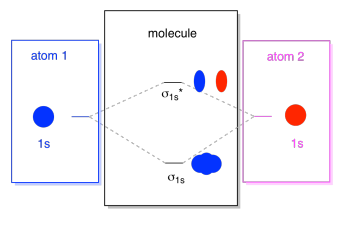
What we run across here is a molecular orbital interaction diagram. The centre of the diagram is merely the molecular orbital energy diagram. It is analogous to the atomic orbital energy diagram (which goes 1s, 2s, 2p, 3s...). The order of free energy so far is σ1s, σ1s*. The sides of the diagram just refer back to where those molecular orbitals came from, with dotted lines to guide you from 1 place to some other. Altogether, the motion picture says that the 1s orbital on ane cantlet and the 1s orbital on the other atom can combine in two different means, producing the lower-energy, bonding σ1s and the higher-energy, antibonding σ1s*.
Note that we have not added whatever electrons to that molecular orbital energy diagram yet, merely when we do, we will merely fill them in from the lesser up, just like nosotros would an atomic orbital energy diagram.
The next everyman fix of atomic orbitals is the 2s level. These spherical orbitals would combine very much like 1s orbitals, and we would become a similar diagram, only at a slightly higher energy level.
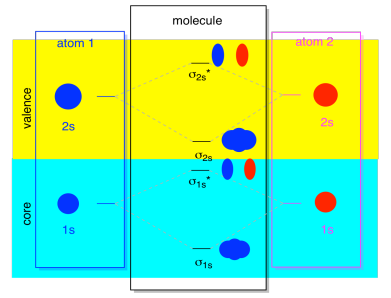
Most of the time, we aren't going to meet both the σ1s and the σ2s displayed in the diagram. That's considering if there are any 2s electrons, so those 1s electrons are really cadre electrons, not valence. They are cached a petty deeper in the cantlet, and they don't play a very of import role in bonding. Ignoring the cadre electrons is pretty common; if you call back, in atomic electron configurations nosotros might write [He]2s22p4 instead of 1stwo2s22p4 for oxygen; we were ignoring the core. When we drew Lewis structures, we gave oxygen half-dozen electrons, rather than eight; we were ignoring the cadre.
In the context of MO, suppose nosotros practise have 2s electrons. That must mean that each cantlet has two 1s electrons of its own, for a full of four. When those four electrons are filled into the MO diagram from the bottom up, they will occupy both the bonding σ1s and the antibonding σ1s*. The effect of both those combinations being occupied is to cancel out the bonding; those two pairs of electrons remain non-bonding. And then we can ignore them and we aren't really missing anything.
The 2s orbitals aren't the just ones in the second shell. There are also 2p orbitals. Remember, there are a couple of very unlike ways in which p orbitals tin can combine with each other, depending upon which axis they lie. If they do non lie parallel to each other -- that is, if they are perpendicular to each other, such equally a px and a py -- then they cannot interact with each other at all. The pz on one atom could interact with the pz on the other atom, nonetheless, considering they are parallel to each other.
Normally, we define the z centrality as lying along the line between the two atoms we are looking at. Two pz orbitals would lie along that axis, each with a lobe extending into the infinite between the atoms, and each with another lobe extending abroad, in the other management
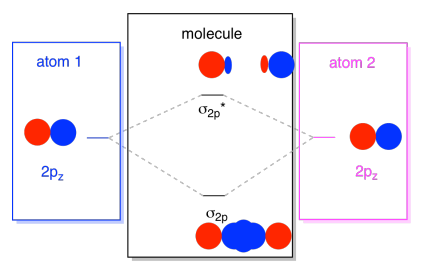
The resulting combinations are chosen σ because they practice lie along the centrality between the atoms (that's exactly what σ means, in terms of bonding). There is a σ combination, if the overlapping lobes are in phase with each other, and σ* combination, if those lobes are out of phase with each other. Considering these new orbitals arise from the atomic 2p orbitals, nosotros call them σ2p and σ2p*.
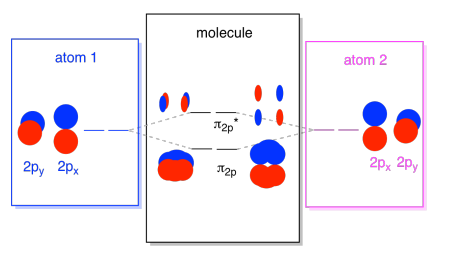
There are as well those p orbitals that practice not lie along the bail axis, or the axis betwixt the two atoms. The px orbitals are perpendicular to the pz orbitals we just looked at, and therefore perpendicular to the axis betwixt the bonds. However, they are still parallel to each other, and they can still form combinations. These 2 orbitals would grade an in-phase combination and an out-of-phase combination.
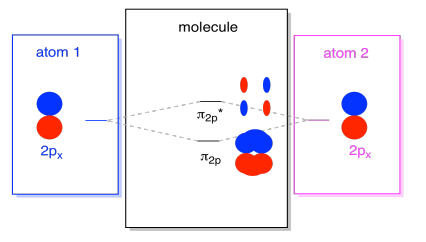
Note that the energetic separation between these ii combinations is a piddling smaller that the gap between the σ2p and σ2p* levels. The difference is related to the degree of overlap between the atomic orbitals. The on-axis orbitals projection strongly into the aforementioned infinite; they overlap a lot, and they interact strongly. The off-axis orbitals castor against each other, interacting less strongly, and resulting in smaller energetic changes. The gap betwixt the π2p orbital and π2p* orbital is therefore much smaller than the ane between the σ2p and σ2p* orbitals.
There are really two of those off-axis p orbitals. In addition to the px fix, we would have a py prepare. If the px ready is in the plane of the screen, the py set up has i orbital sticking out in front and one hidden behind. All the same, the combinations betwixt the two py orbitals are exactly the same as what we saw between the two px orbitals. They are just rotated into a perpendicular plane with respect to the px combinations.
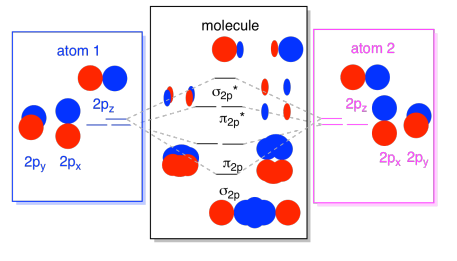
We tin can put all of those 2p-based orbitals together in i diagram. It's starting to get a little more crowded, only this diagram is just a combination of the pieces we take already seen. Note that the pten, py, and pz diminutive orbitals all start out at the same energy (we take stacked them here so that you can nonetheless run across the correlation between the diminutive and molecular orbitals). That ways that the π2p & π 2p* orbitals will be "nested" between the σ2p & σ2p* orbitals.
Finally, keeping in mind that the 2p orbitals are higher in free energy than the 2s orbitals, we tin combine those pictures into one diagram. Again, we have seen these individual pieces earlier; we are just assembling them now.
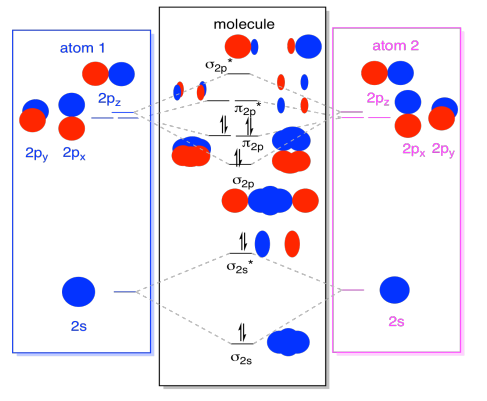
While nosotros are at it, nosotros tin can can add in the electrons. How? It's but the total number of valence electrons. For an example, we take used N2. Each nitrogen has five valence electrons, for a total of 10, so we have just filled in 10 electrons, starting at the bottom of the molecular orbital energy level diagram. If this were another molecule, such as Ftwo or O2, we would construct the overall diagram in a similar way, merely just use a different number of electrons.
The orbital picture we have described above is really only a potential picture of the electronic structure of dinitrogen (and any other main group or p-cake diatomic). We won't become a real moving picture of dinitrogen's construction until nosotros populate these potential levels with electrons.
- But the energy levels with electrons have an effect on the free energy (and behavior) of the molecule.
In other words, the energy of the electrons determines the behavior of the molecule. The other energy levels are only possibilities that remain unfulfilled.
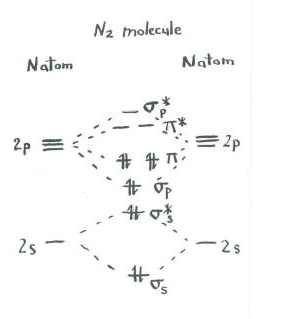
Think about the picture of dinitrogen.
- Each nitrogen has five valence electrons.
- There are a total of ten electrons.
- Ii each get into the s s bonding and s s * antibonding levels. Remember, we kept these separate from the p fix equally a simplification.
- Two each become into the due south p bonding and each of the p bonding levels.
The remaining orbitals (s p * antibonding and each of the p * antibonding levels) are unoccupied. These are imaginary levels that do non play a role in determining the energy of dinitrogen. In a existent molecular orbital adding, the electrons in these levels would contribute to the overall energy of the molecule.
Nosotros get additional information from this picture. For instance, we tin see the bond society in dinitrogen.
- Bond lodge is simply the number of bonds between a pair of atoms.
- The bond order is ane of several factors that influences the force of the covalent bond.
- The college the bond social club, the more electrons are shared between the atoms, and the stronger the bond.
In dinitrogen, the due south south bonding southward s * antibonding levels cancel each other out. One pair is lower in free energy than it was in the atom, simply the other is higher. There is no internet lowering of energy. These electrons do not contribute to a nitrogen-nitrogen bond. These are non-bonding electron pairs.
The six electrons in the due south p bonding and the p bonding levels, however, correspond a decrease in energy from the energy levels in the gratuitous nitrogen atoms. These three, low-energy pairs of electrons point three bonds between the nitrogen atoms.
Remember, we accept fabricated some short-cuts in this flick, and a real molecular orbital calculation could give slightly unlike results. Nevertheless, information technology would still reveal a bond club of three as well as two not-bonding electron pairs.
In addition, sometimes molecular orbital pictures are shown in different means. A molecular orbital interaction diagram shows how atomic or molecular orbitals combine together to make new orbitals. Sometimes, we may be interested in only the molecular orbital energy levels themselves, and not where they came from. A molecular orbital energy level diagram simply shows the energy levels in the molecule. Frequently, but non ever, energy level diagrams are shown without any pictures of the orbitals, in order to focus attention on the energy levels, which in a primal fashion are the most important part of the picture. Furthermore, considering only the occupied free energy levels actually contribute to the energy of the molecule, sometimes the higher-energy, unoccupied orbitals are left out of the picture.
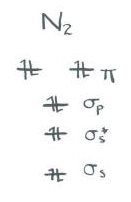
Very often the results of molecular orbital calculations reinforce what we would predict from Lewis structures. If you lot draw a Lewis structure of dinitrogen, you volition also predict a triple nitrogen-nitrogen bond. The primary reward of molecular orbital theory is that it allows quantitative prediction of energy when nosotros do a real adding on a calculator. In addition, information technology is important to realize that there is no real reason for the octet dominion unless we consider quantum mechanics. Lewis structures are founded on an empirical ascertainment that electrons form pairs and octets, without attempting to explain why. Molecular orbital theory takes some fundamental relationships from physics and applies them to very complicated molecules with very skillful success. Just by knowing the number of electrons in the molecule, and by knowing approximately where the nuclei are located in the structure, molecular orbital calculations give very useful information about energy. In improver, in more complicated cases than Ntwo, these calculations can fifty-fifty correct our first guess about molecular geometry and where the bonds are located.
Exercise \(\PageIndex{ane}\)
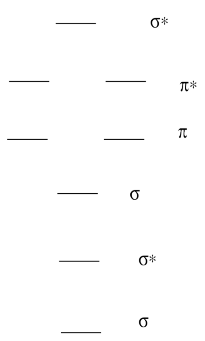
A Molecular Orbital Diagram for a diatomic molecule (2 atoms) ever has the same basic pattern.
- Draw a movie of the levels.
- Label each level with σ, σ*, π, π*
- Answer
-
Exercise \(\PageIndex{2}\)
A Molecular Orbital Diagram for a diatomic molecule (two atoms) varies in the number of electrons. How practise you populate the electrons?
- Answer
-
• Count the valence electrons on the molecule. That'south the number of valence electrons on each cantlet, adapted for any charge on the molecule. (eg C2 2- has 10 valence electrons: 4 from each carbon -- that'southward 8 -- and two more for the 2- charge).
• Fill electrons into the lowest free energy orbitals first.
• Pair electrons after all orbitals at the same energy level have ane electron.
Exercise \(\PageIndex{3}\)
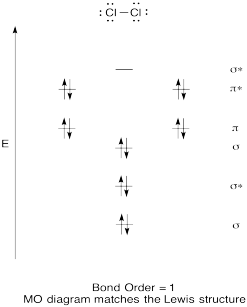
Construct a qualitative molecular orbital diagram for chlorine, Cl2. Compare the bond order to that seen in the Lewis construction (call up that an electron in an antibonding orbital cancels the stabilization due to bonding of an electron in a bonding orbital).
- Answer
-
Do \(\PageIndex{four}\)
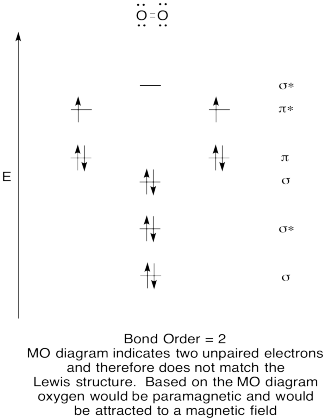
- Construct a qualitative molecular orbital diagram for oxygen, O2.
- Compare the bond order to that seen in the Lewis construction.
- How else does this MO picture of oxygen compare to the Lewis construction? What do the two structures tell you lot almost electron pairing?
- Compounds that have all of their electrons paired are referred to as diamagnetic. Those with unpaired electrons are referred to as paramagnetic. Paramagnetic materials are attracted by a magnetic field, but diamagnetic things are not. How would you expect molecular oxygen to behave?
- Answer
-
Practise \(\PageIndex{five}\)
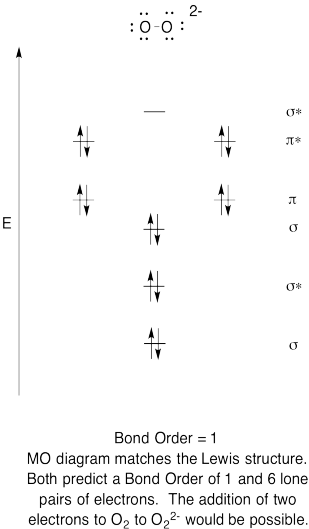
- Construct a qualitative molecular orbital diagram for peroxide anion, O2 two-.
- Compare the bail lodge to that seen in the Lewis construction.
- How else does this MO picture show of oxygen compare to the Lewis structure? What practise the 2 structures tell yous near electron pairing?
- Based on molecular orbital pictures, how easily do you think dioxygen could exist reduced to peroxide (through the add-on of two electrons)?
- Answer
-
Exercise \(\PageIndex{six}\)
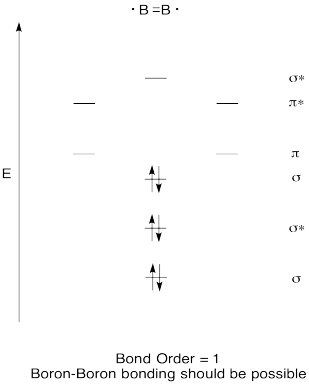
Construct a qualitative molecular orbital diagram for diboron, B2. Practise you remember boron-boron bonds could grade easily, based on this motion picture?
- Respond
-
Exercise \(\PageIndex{7}\)
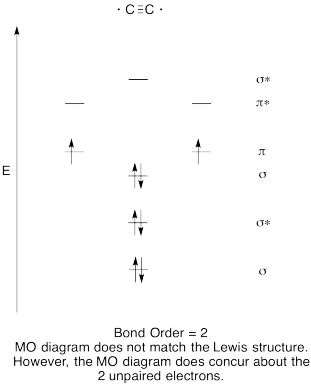
- Construct a qualitative molecular orbital diagram for dicarbon, Cii.
- Compare the bond order to that seen in the Lewis structure.
- How else does this MO motion-picture show of oxygen compare to the Lewis structure? What exercise the two structures tell you about electron pairing?
- Answer
-
Exercise \(\PageIndex{8}\)
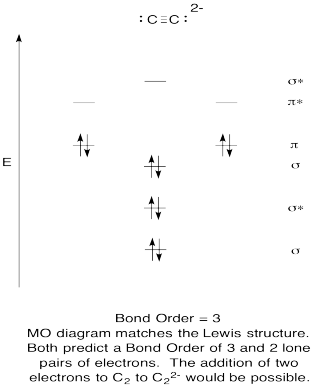
- Construct a qualitative molecular orbital diagram for acetylide anion, C2 2-.
- Compare the bond gild to that seen in the Lewis construction.
- How else does this MO picture of oxygen compare to the Lewis structure? What do the 2 structures tell you nigh electron pairing?
- Based on molecular orbital pictures, how easily practise you think dicarbon could be reduced to acetylide (through the improver of ii electrons)?
- Answer
-
Practise \(\PageIndex{9}\)
Make drawings and notes to summarize the upshot of populating antibonding orbitals.
- Answer
-

Practice \(\PageIndex{x}\)
Researchers at Johns Hopkins recently reported the formation of NaivAltwo in a pulsed arc discharge (they put a lot of electric current through a sample of sodium and aluminum; Xinxing Zhang, Ivan A. Popov, Katie A. Lundell, Haopeng Wang, Chaonan Mu, Wei Wang, Hansgeorg Schnöckel, Alexander I. Boldyrev, Kit H. Bowen, Angewandte Chemie International Edition, 2018, 57(43), 14060-14064. Copyright 2022, John Wiley & Sons. Used with permission.).
- The compound is ionic. Explain which atoms form the cations, based on periodic trends.
- Therefore, what atoms course the anion?
- The anion is ane molecule. What is the charge on this molecule?
- Show how to calculate the total valence electrons in this molecular anion.
- Draw a Lewis structure for this molecular anion.
- Construct a diatomic molecular orbital energy level diagram for this molecule. Characterization the energy levels (sigma, pi, etc.) and add in the correct number of electrons.
- Show how to calculate the bond order in the molecule.
- Respond
-
a) Na, because Na has a lower ionization potential (and a lower electronegativity) than Al.
b) Al
c) 4-, because there are four Na+
d) total e- = two x 3 e- (per Al) + 4 e- (for the negative accuse) = 10 e-

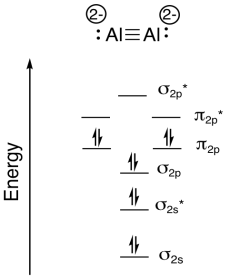
g) \(\textrm{bond order} = \frac{( \# bonding \: e^{-} - \# antibonding \: 3^{-})}{2} = \frac{8-2}{two}= three\)

Source: https://chem.libretexts.org/Courses/Saint_Marys_College_Notre_Dame_IN/CHEM_342%3A_Bio-inorganic_Chemistry/Readings/Week_3%3A_Metal-Ligand_Interactions_continued..../3.3%3A_Molecule_Orbital_(MO)_Theory/3.3.4%3A_Assembling_a_complete_MO_diagram
Posted by: burrowsbegather45.blogspot.com
0 Response to "how to draw a molecular orbital diagram"
Post a Comment